 Sophie Mathewson
Published on
Sophie Mathewson
Published on
Sabrina Dowling Giudici
Italian-Australian glass artist Sabrina Dowling Giudici stands in a small Carnarvon gallery, chatting to locals as they drift through her latest exhibition. It’s an understated scene for an artist whose work has led World Heritage art-science work for the World Congress of Conservation, lectured at the International Biennale of Glass, and twice been included in The Venice Glass Week.
But the contrast is fitting. Because while Sabrina’s practice carries stories of the Gascoyne to audiences in Europe and beyond, she remains deeply anchored to the regional community that shaped her. In many ways, she has become an unofficial cultural ambassador for the Gascoyne: translating the light, ecology and texture of the region into glass works that travel far beyond it.

It’s opening day for Sabrina’s latest exhibition, ‘Blown Away’, where she presents her latest art stories for local review before sharing them beyond the Gascoyne borders. The morning follows a certain country-town rhythm. The pace is choreographed at what you might describe as “Carnarvon time”, with locals starting up conversations on the footpath before even walking through the gallery doors. People drift in and out of the space, pause in front of a work, disappear for a coffee, then return half an hour later with somebody else they think ought to see it.
Questions about glassmaking give way to stories about fishing conditions, mutual acquaintances and the aftermath of the latest cyclone. Sabrina moves comfortably among it all, stepping into conversations as easily as she steps out of them, and after a while, you get the sense that whatever she is doing now as an artist sits on top of a much longer history of belonging to this place and showing up for the people in it.
The Pathway to Glass
Sabrina describes herself as “Old Carnarvon”, and says it is a rare place in Australia where her Italian surname is pronounced correctly and without hesitation. But like many people who grow up in regional WA, she has built a pattern of leaving and returning, but always bringing knowledge back to town with her.
Her early career was, by any conventional measure, a success. She earned a Commerce degree from UWA and spent two decades building a career in Perth’s corporate sector.
“I had a BMW, high heels and an office on the tenth floor of QV1,” she says. On paper, it certainly looked like she had it all, but Sabrina remembers that period differently. Beneath the outward markers of success sat a growing feeling that she was disconnected from herself and from the things she valued most.
“It was a time that felt disassociated and ungrounded,” she says.
Sabrina returned to Ph.D. research, this time in Regional Development, and in doing so stepped back into a way of thinking that placed value on relationships, place, and the environment.
Then, after finding her footing again in Carnarvon, she arrived at a decision that would reshape her life entirely: she would become an artist.
The Medium
Sabrina chose to work with glass, which was not exactly the convenient option. There are no glass schools within a few thousand kilometres of Carnarvon, but she was drawn to the medium because of its relationship with light.
For Sabrina, light is central to telling stories of the Gascoyne. It has a constant presence in the region in the way that it’s relentless and reflective – and she felt that glass had the capacity to share that intensity.
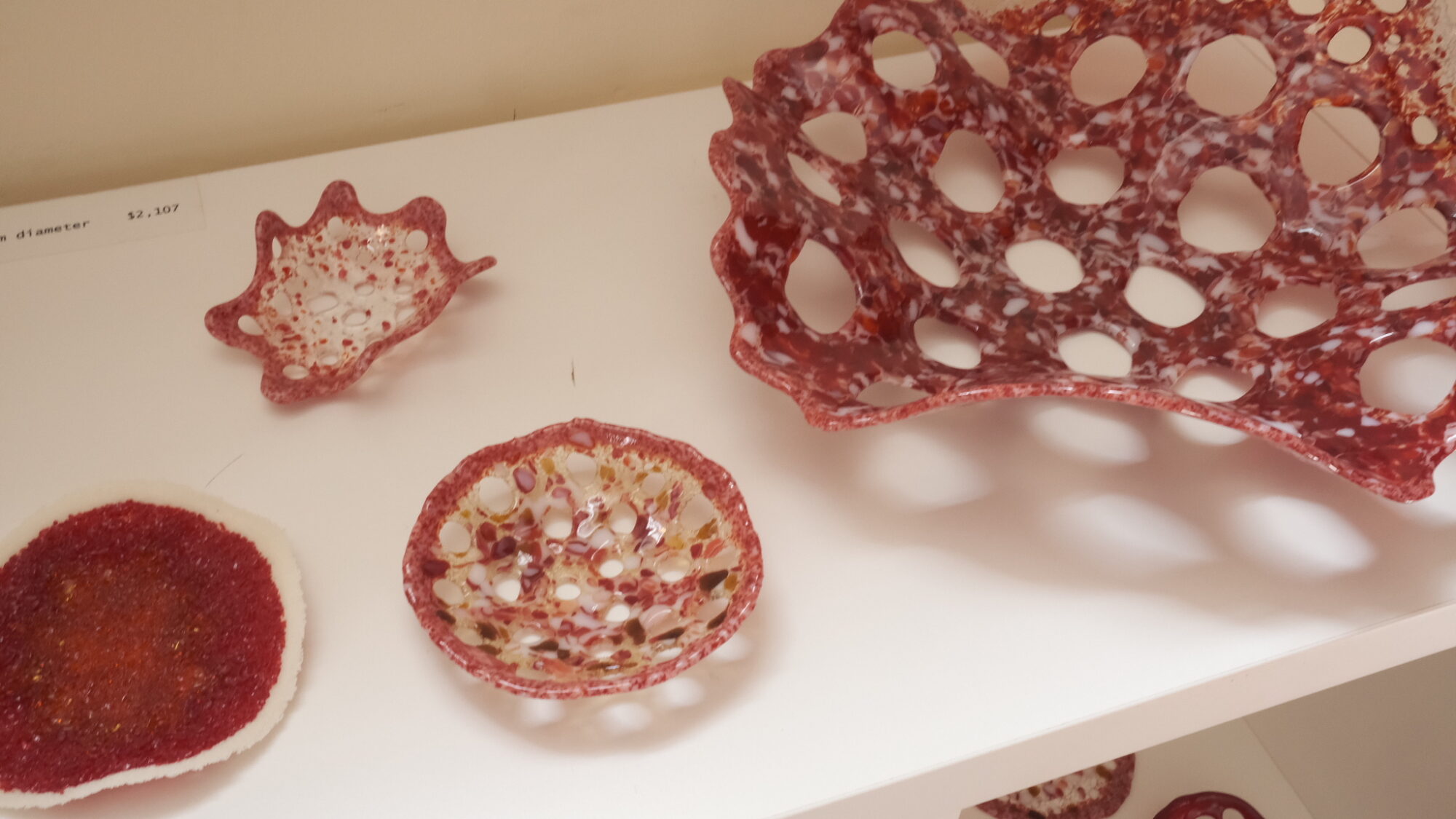
While many kiln-formed glass artists rely on sheets of glass, Sabrina gravitated towards crushed glass instead, a choice that connects back to her Italian heritage and the terrazzo work of her grandfather, with its speckled surfaces and organic texture.
When I ask how she creates the pieces with small holes running through them, she smiles and says it is one of the questions she is asked most often.
“The holes are a result of gaming the chemistry and physics,” she says. “When you melt glass, it always melts to six millimetres. If you heap glass higher, it spreads out. If you heap it lower, it rises up. By layering the glass under the six mils, it forces the glass molecular structure to pull upwards as it reforms under intense, melting heat. Then by choosing combinations of certain glass colours, the chemical reactions create interesting colour effects.”
The small apertures that appear throughout her work, catching and refracting light, feel strangely cellular and are suggestive of coral or microscopic organisms… maybe even distant planetary surfaces. In a town historically linked to space tracking and deep isolation, the association feels somewhat fitting.


Environmental Stories in the Work
The stories within Sabrina’s glass works are always environmental, to showcase generally unknown facts about local landscapes. Sabrina is particularly drawn to seagrass meadows – marine ecosystems that rarely attract the same public attention as coral reefs despite performing extraordinary ecological functions of producing oxygen and sequestering carbon.
“My favourite line, especially with kids,” Sabrina says, “is that in the equivalent area of Amazonian rainforest and a seagrass meadow, the seagrass can pump out fifteen times more oxygen. It’s just prodigious.”
In a town like Carnarvon, conversations about the environment surface constantly. Cyclones, fishing reports, and the daily tides are folded naturally into everyday discussion. During my visit, Cyclone Narelle had only just passed through, and locals talked about her like a long-lost relative who has blown through town.
“Narelle’s caused all manner of havoc,” one local tells me. “But the fish populations are thriving in the aftermath, and the crabs are fat, so that’s been good.”
It’s all reported on like a bit of gossip about somebody everyone knows well.
Taking the Gascoyne to the World
For a region so vast (more than 600 kilometres of coastline and home to only around 10,000 people), there remains a sense that much of the Gascoyne is still relatively unknown.
Yet the region holds some of Australia’s most extraordinary environmental landscapes. The highlights being the Ningaloo Coast, Shark Bay World Heritage sites, the world’s largest inland mangrove forest at Lake Macleod, the world’s largest monocline rock at Burringurrah, and WA’s longest river (the Gascoyne), all with incredible biodiversity.
And through Sabrina’s work, fragments of the Gascoyne have had the opportunity to travel outward into foreign galleries and into conversations far removed from Carnarvon itself. To European audiences, Sabrina says this part of Australia can sound almost mythic and improbable.
“Our land here is ancient and more obvious,” she says. “And they appreciate that.”
Perhaps that’s what her work does best. It bends and refracts the familiar, allowing people to see it differently. Sabrina’s art catches the light and shifts perspectives.
The stories of the Gascoyne are not necessarily new. The coastlines, currents, seagrass meadows and extraordinary landscapes have been there for millennia. Her work simply helps us see them.

Posted in Artist of the Month, Gascoyne, News & Stories.