 Sophie Mathewson
Published on
Sophie Mathewson
Published on
Artist of the Month: Annette Carmichael
When Annette Carmichael moved to Denmark with her husband and two young children, she did what any newly arrived arts professional might reasonably do, and wandered into the local arts org to announce herself.
She turned up to Denmark Arts one day, introduced herself with what she describes as a level of inner smugness (a professional, a degree, here to show the locals how it’s done), and within two weeks was running the place, because the woman at the desk stood up, said she was moving back to Sydney, and left (reportedly mid-sandwich).
“I walked into the office to start my first day and her sandwich packet was still on the desk.” Annette remembers with a laugh.
Annette’s first encounter with the Board was similarly bracing. The Chair arrived with no shoes and sandy feet, radiating enthusiasm. No professional attire or serious exchange. It was quite the contrast to what Annette had experienced in her previous roles in Perth and London.
“I was so snobby,” Annette says with candour. “I was like, ‘I’m this professional from the city. I have a degree in Arts Management. I’m going to tell you all how it’s done’,'” she laughs. “And then, man, did I learn.”
Denmark, in other words, knocked any sense of poshness out of her. And it also changed the course of her career.
These days Annette leads Southern Edge Arts in Albany, down the coast from Denmark, and right now she’s preparing for Carrying the Fire: a vast community performance that will send thousands of people carrying handmade lanterns along five kilometres of coastline this November.
It sounds wildly ambitious, but wildly ambitious is just what Annette does.
How She Got Here
Annette grew up in Port Hedland, started ballet at six and, by nine was producing shows with her twin sister and the neighbourhood children in the family lounge room. There were sets and scripts and rehearsals, and a nine-year-old Annette, who ran the whole operation like a small, exacting union boss.
“My parents used to tell this story of them sitting there with a glass of wine, watching me direct these kids and being so strict,” she chuckles. “Apparently I’d give the kids a ten-minute break then get them straight back into rehearsing.”
After studying Arts Management at WAAPA, she landed at what was then the Festival of Perth, where director David Blenkinsop had one rule for his staff; see every show. Few starter jobs come with that kind of cultural immersion and Annette spent two years taking in contemporary dance, theatre and international artists she’d never had access to before.
With the influence of international performance, she made her way to London, where alongside working as a professional dancer, Annette also started volunteering with a community dance organisation, observing their work with migrant communities, people with disabilities and low-socioeconomic groups, and doing movement workshops as a form of identity building and social cohesion. It was a corner of the arts that barely existed at that time in Australia (and something that would influence her future work in regional WA).
Once back in Perth at the turn of the millennium, Annette took a job as Executive Administrator at the West Australian Ballet, arriving in the middle of the Nugent Inquiry into Australia’s major arts organisations, which proved a genuinely rigorous period to be sitting inside one of them. Watching then CEO Louise Howden Smith negotiate the company through all of it, gave Annette a formidable education in the mechanics of arts leadership.
Then the country called, as it does, and Annette and her husband, both still doing contract work for Perth organisations, redirected themselves to the regions. They chose Denmark for charmingly unstrategic reasons; he liked the ocean, and she loved the forest, and what they stumbled into was a town that was far more receptive to creativity than either of them had expected.
When the folks of Denmark discovered Annette could choreograph, their response was essentially: “well, why aren’t you?” So, she tested the proposition, borrowing the methodology she’d encountered in London, and put out a call for 100 locals to join a project. And 100 locals turned up. Annette thought “Gee, I can do anything here.'”
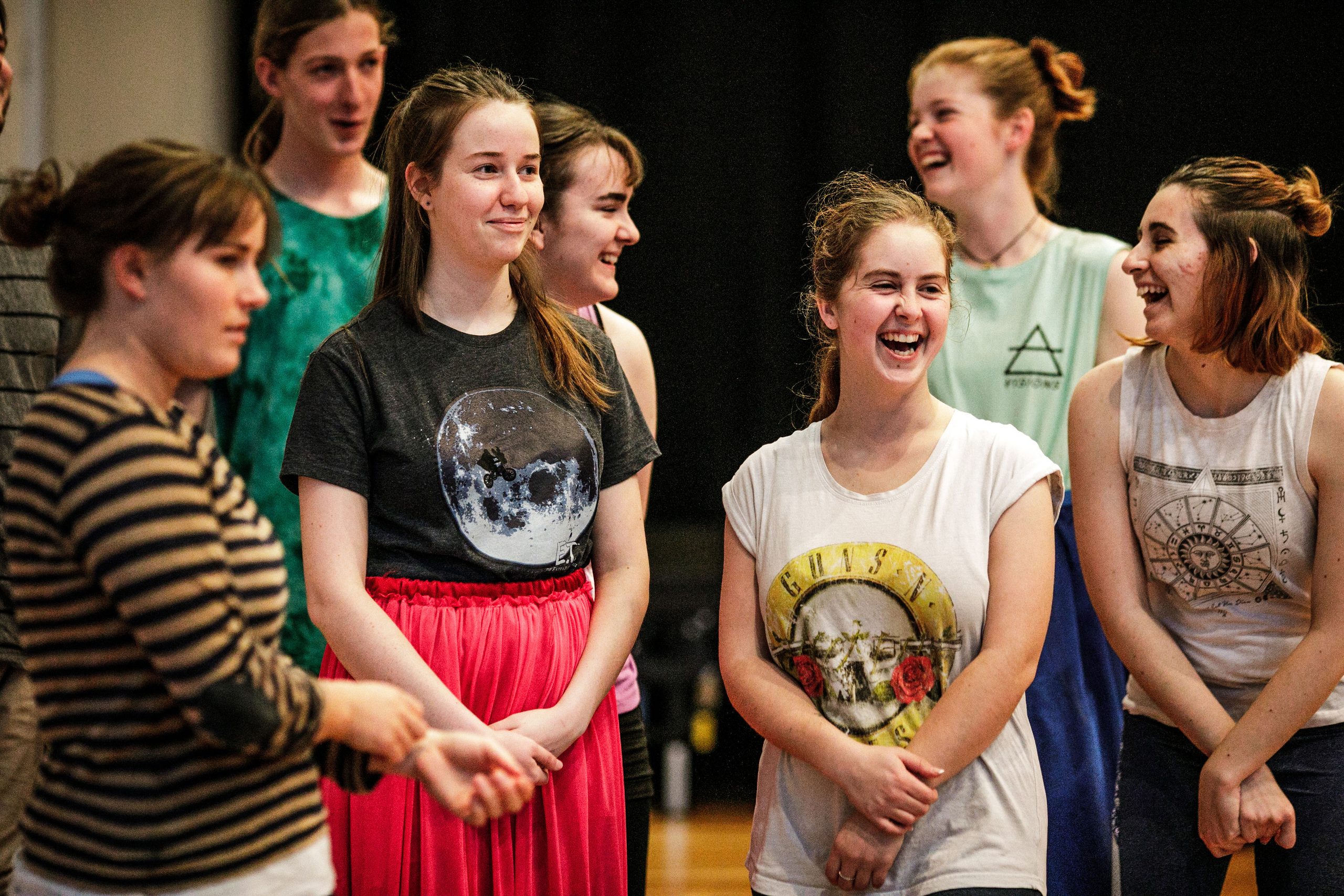
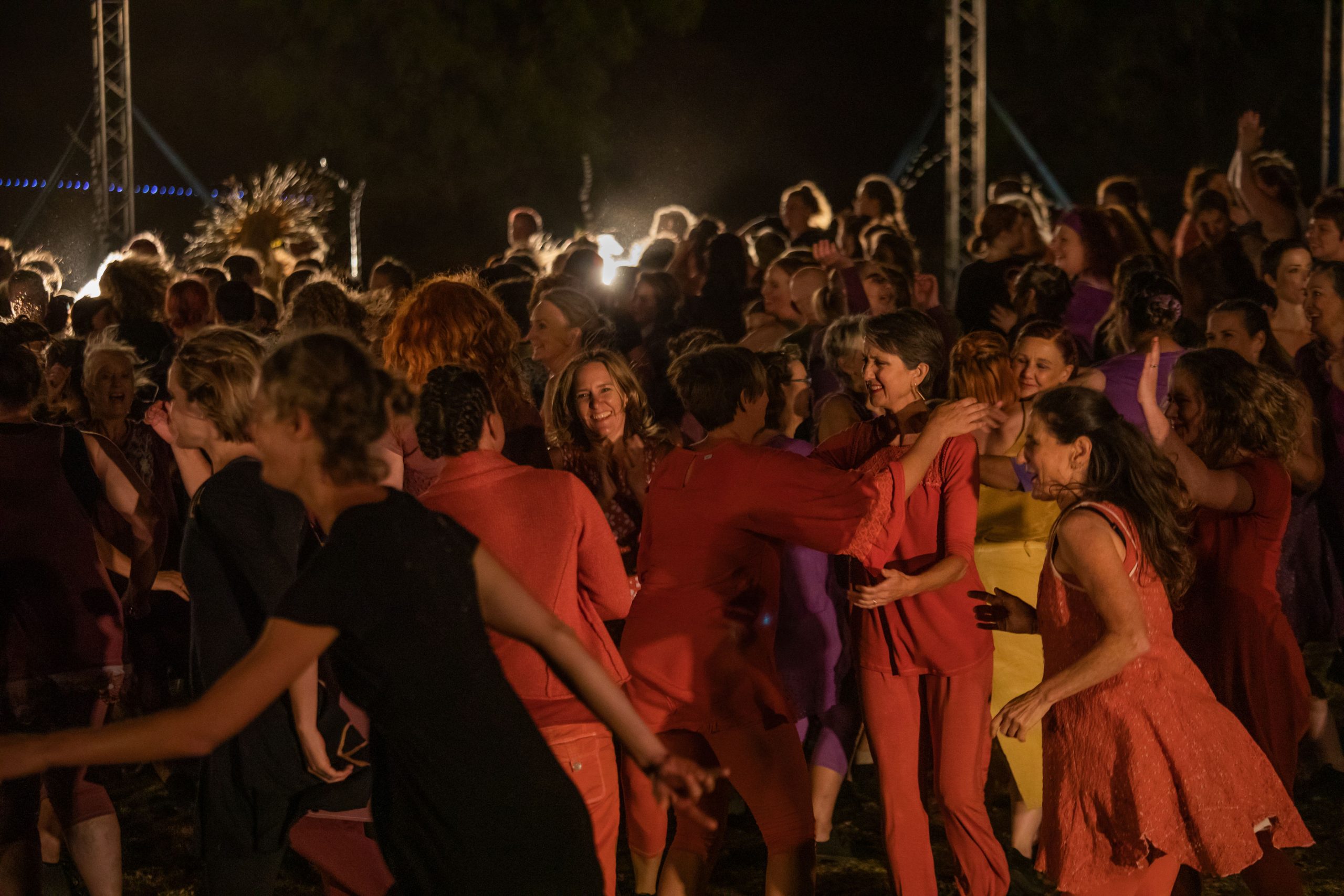
All photos by Nic Duncan, supplied by Annette Carmichael.
The Beauty Index
The Beauty Index was a project that started in 2016, when Annette began to feel rather bleak with the state of the world. “My alarm clock radio would wake me up to the news,” she said. “It was around the time that ISIS was dominating the media cycle and I got to a point where I just felt this huge despair… like, what’s the point of being an artist in a world like this?”
She turned inward and asked the question of where beauty could be found, specifically, its capacity to hold onto something human in the face of violence. She wondered whether she could explore that through a contemporary dance work with men, so she gathered a group of ordinary blokes from Denmark and made The Beauty Index.
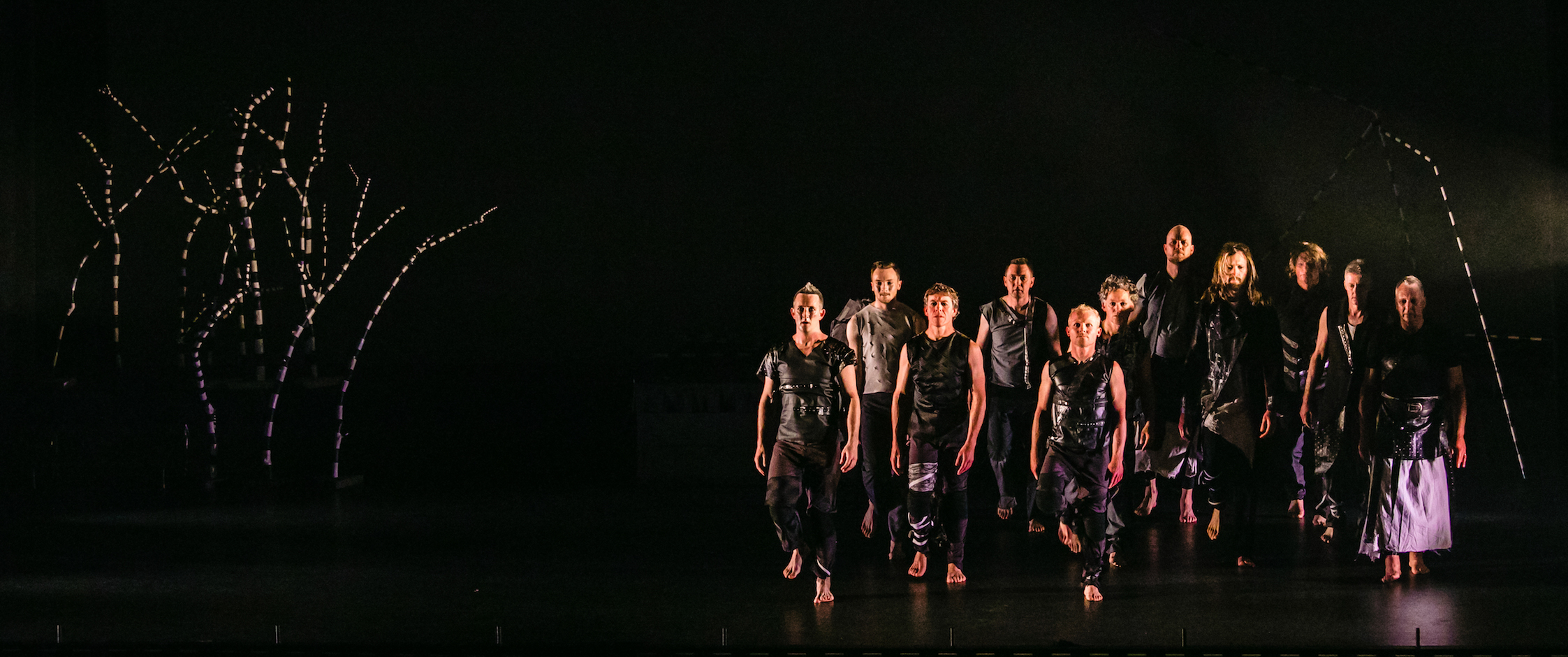
The first show opened in 2017 at a derelict mill site, with a cast of 15 local men (most with zero dance background) exploring beauty as a counterweight to violence.
The show was meant to be a one-off but instead it became a trilogy: The Beauty Index, then A Light Shade of Red (made with young people around the centenary of Armistice Day) then Chorus, a work explicitly framed as a call to end violence against women, built with roughly 200 women from five southern communities, 150 of whom made it onto the stage. After that, The Beauty Index itself toured and new versions were built from scratch with local men in Ravensthorpe, Kalgoorlie, Moora, Harvey, and Mandurah.
A regional touring report by Circuitwest (PDF) later credited the show with doing something that had been wrestled with for years. It got men actively participating and into the room, both as performers and as an audience. The show managed to bring men into the work on stage and, just as impressively, as active viewers.
Annette describes her practice as looking for what is “virtuosic about the everyday person” – the things people carry around without recognising them as extraordinary. Participants, she says, “often come away amazed by having done something they were certain they couldn’t do”.
Carrying the Fire
At her role as Artistic Director of Southern Edge Arts, a youth arts organisation working across circus, theatre and community practice, Annette’s newest project is built around that same instinct, only considerably scaled up.
On Saturday November 7th, Carrying the Fire will stretch along the Albany-Kinjarling coastline from Emu Point to Binalup/Middleton Beach. Thousands of people will walk carrying handmade lanterns, creating a vast, temporary river of light to be captured from above. A specially developed app will control participants’ phone torches, allowing patterns of light to move through the crowd.
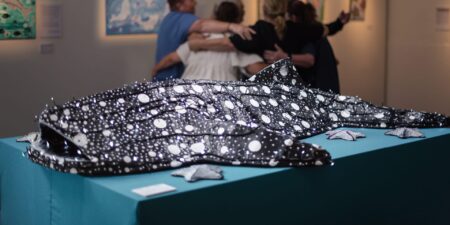
The project was conceived by FORM, who then approached Annette to lead. Developed over two years, it asks one question: what do we carry into our shared future? In Albany’s bicentenary year, that question carries real weight. It has been developed in consultation with the Albany 2026 Cultural Advice Sub-Committee, coordinated by Wagyl Kaip Southern Noongar Aboriginal Corporation, and Menang cultural consultant and artist Penny Williams, who has been part of the creative team from the outset. Lantern designs draw on Menang Country, including biyarra/banksia, kwoornt/shelter, sea stars and the moodjar flower / Australian Christmas tree.
The event is also, characteristically to Annette’s work, open to everybody.
When you try to draw a line from that nine-year-old in Port Hedland who recruited the neighbourhood children, built the set and ordered everybody back after their ten-minute break, you can see she really hasn’t disappeared… her neighbourhood has just grown bigger.
For more documentaries about Annette’s past projects: https://www.youtube.com/@annettecarmichael412
Carrying the Fire takes place in Albany-Kinjarling on Saturday 7 November 2026.
Southern Edge Arts is a proud member of our Regional Arts Network (RAN), a state-wide network of not-for-profit arts and cultural organisations established by Regional Arts WA. Arts and culture are the lifeblood of all regional communities, and the RAN provides peer-to-peer support through connection, learning and collaboration.
The Regional Arts Network initiative is proudly supported by Minderoo Foundation. Previously supported with The Ian Potter Foundation, and funding from the Australian Government’s Regional Arts Fund.
Posted in Artist of the Month, Great Southern, News & Stories, Regional Arts Network, Sector News.