 Sophie Mathewson
Published on
Sophie Mathewson
Published on
A Dad & Daughter in Denmark
For this month’s Artist of the Month – we visited two artists in the Great Southern, Paul Moncreiff and Tessa Moncrieff. An artistic Dad and Daughter duo.
This article is written by Sophie Mathewson and is Part 1 of the series.
Part 1: The Dad
The drive from Walpole to Kentdale is beautiful, winding through karri forest until you find yourself at Kent River Studio, the home and creative workspace of Paul Moncrieff. You know you’re in the right place when you spot the handwritten signs: one advertising worms, the other offering complimentary donkey manure. It’s a welcome that tells you a bit about the environmentally conscious folks who live here.
As I pull in, Laddie and Bonnie, two collie dogs, announce my arrival, and when Paul greets me, he offers tea, coffee, beer, or cider – the full repertoire of hospitality. After the formalities, he gestures towards the veggie garden and little paddock beyond. “Come meet Frank and Joseph.”
Frank and Joseph are of course the donkeys – who eye me with what I can only describe as benign indifference. Jillian Green (Paul’s partner and also an exceptional artist) knits saddles for them, Paul tells me. They take them down to the beach regularly. I try to imagine this scene; donkeys with handmade saddles on the sand, the Southern Ocean stretching out, and I file it away as something I’ll need to see.


Paul’s Work
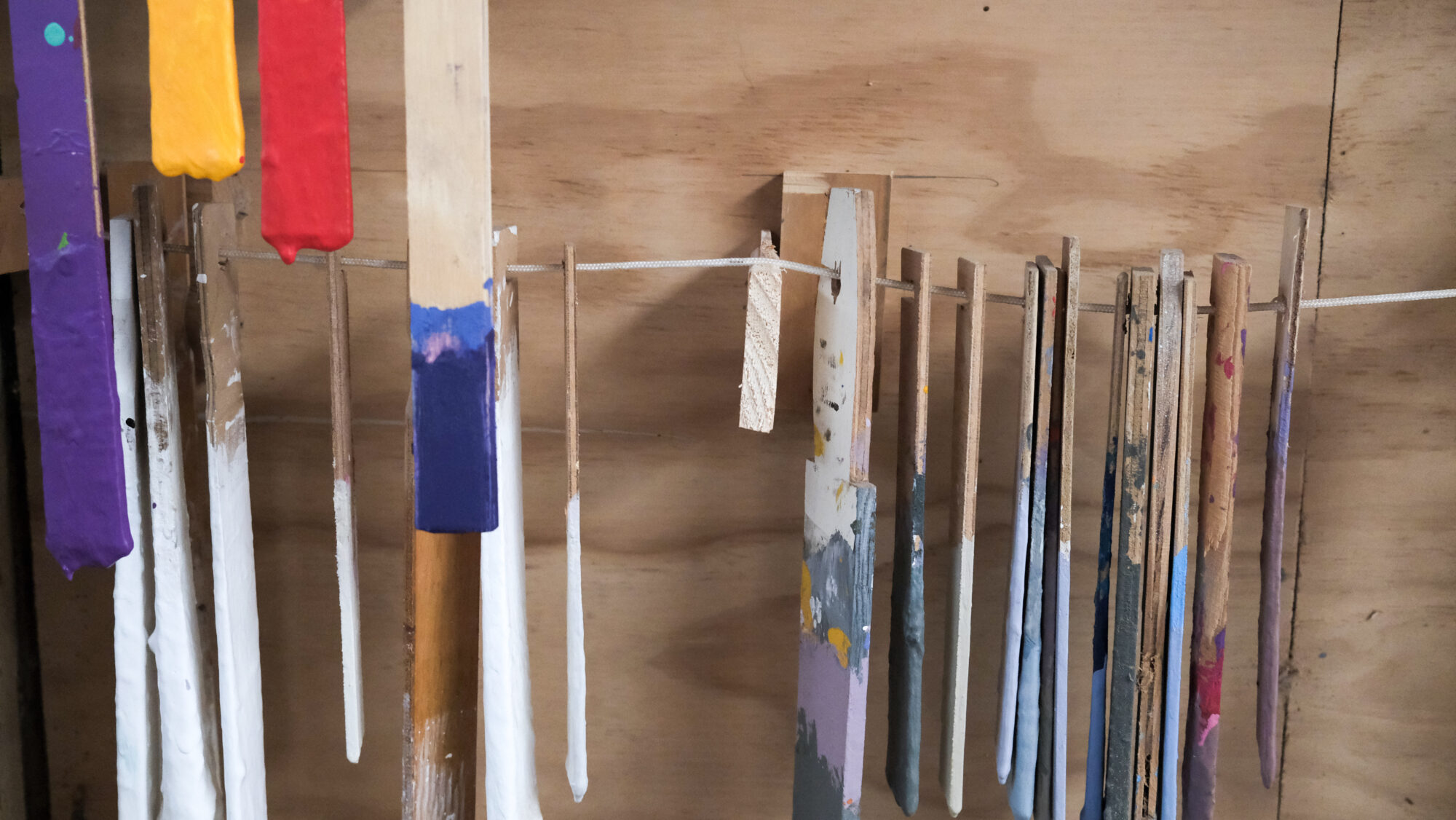
Paul’s studio sits apart from the house, both of which he built himself. Inside, the space is working and lived-in. There’s a stack of CDs, but these days Paul admits that he listens to Spotify’s AI ‘DJ X’ while he works. He laughs about how the algorithm seems to have him figured out. “He knows I have no hair,” Paul says incredulously. “And somehow knows I play the blues!”
There are multiple works underway in the studio. A bottle of wine sits next to one of the paintings, though Paul tells me he hasn’t had a drink in five months. It’s an ironic detail, given he’s preparing for a solo exhibition about wine at Vasse Felix.
The exhibition, with the working title Palette Palete (spelled differently, he’s quick to clarify), centres on Vasse Felix tasting notes. Paul explains how he has been circling this idea for over 30 years. There’s a poetic language to tasting notes that describe wine. Words that emerge in the notes like champignons, forest floor, burnt nori, limestone dust. They’re evocative, almost painterly, and Paul sees the words as a rich resource to mine.
Paul explains that his work will be paired with a bottle at the exhibition, possibly featuring QR codes so viewers can read about both the wine and the artist.
He has proposed visits to the vineyard itself, to experience the hands-on work of grape picking, the fermentation process, the barrels and stainless steel drums where the wines develop. He’ll make further drawings, ink and watercolour studies, and photographs, which will be used as visual aids that feed back into the studio work at Kent River.
Within minutes of talking with Paul, you get the impression that overthinking his practice would be antithetical to how he works. “I wasn’t certain how this would evolve,” he says of the wine series. “But it is coming together and that’s good because the materials are talking to me.” He shows me charred timber pieces, explains how they relate to tasting notes without illustrating them literally. Small canvases where he’s cleaned his brushes might become a larger work. It’s experimental, intuitive, the opposite of prescribed themes.
“I don’t like the word themes,” he tells me flatly when I ask about them. He launches into a distinction between subject matter and theme that makes clear he’s thought deeply about this, even if his approach appears effortless. Regional arts shows with their prescribed themes frustrate him, with artists responding to someone else’s concept rather than their own subject matter.

On Living Regionally
It’s worth noting that Paul hasn’t always lived in regional WA, and that he has been a significant presence in Western Australia’s art since the 70s. Paul has had dozens of solo exhibitions, shared shows, and participated in countless group exhibitions. His paintings, drawings and prints are held in major public and private collections including the Art Gallery of WA, Artbank, and numerous regional collections. Until 2007, he coordinated the Painting and Drawing programme at Edith Cowan University’s Mount Lawley campus.
Paul is someone who has earned his place in the canon and chooses to live in the country.
I ask him about the move, and what he values about living regionally. Paul’s response is both pragmatic and philosophical. He says that living in the country gives him time to think, away from the city’s frenetic pace. But he’s candid about the pitfalls, and chief among them is the lack of critique. Paul uses Jillian (also a practising artist) as his sounding board, and tests ideas and concepts with her before letting them calcify.
He reflects on how Australians, in general, don’t have a cultural appreciation for the arts. “I don’t mean to sound like a wanker,” he prefaces, “but if Europeans come to visit the studio, they know my influences.
“They might walk in and mention Gerrit Rietveld, whose shapes and lines influence my own work. There’s a cultural literacy in Europe that doesn’t always exist here”, he says. Most Australians, Paul says, just don’t have that frame of reference.
“This might sound like bullshit or wanky….” is a phrase Paul returns to with regularity as a pre-emptive strike against pretension, and yet, what inevitably follows is never bullshit at all. His views are sharp and thoughtful. Observations you want to write down. Paul will happily laugh at his own expense, poke fun at the art world’s affectations, but then slip in something genuinely philosophical. I find myself grinning at the preamble then pausing at the insight – because he’s right, and he knows it, and he’s already moved on to the next thought before you’ve caught up with the last one.
Paul grows his own food here. Has built with his hands the place where he and Jillian spend their days making art, tending to the garden, and feeding animals. The rhythm is dictated by the seasons, and the light, and whatever the materials are telling him on any given day.

Before I leave, the dogs circle again and Frank and Joseph watch from their paddock with that same benign indifference. It’s easy to understand why someone would build this life. The coast here is so striking, the karri forest so quiet on the drive back out. Paul doesn’t seem particularly interested in profile anymore, he’s past caring about that. But he’s grateful to be a practising artist, to have this space, these people, and this particular patch of the Great Southern. And when you see it; the studio, the veggie garden, those handwritten signs for worms and donkey manure – you understand that this isn’t a retreat from the world. It’s just a clearer view of what matters.
Exhibitions Not to Miss
Time To Burn
Paul is among several artists participating in Time to Burn, a group exhibition curated by Chrissy Gregory at Vasse Felix, Cowaramup, from 4 April to 27 June. The show examines the current Department of Biodiversity, Conservation and Attractions burning regime, with Paul contributing three works from his AFTER SERIES, including after reflection.
Palette Palate
Paul’s solo exhibition at Vasse Felix, scheduled for mid to late 2027 with a potential run at Holmes à Court Gallery in Perth, remains under wraps for now. What can be said is that it centres on the poetic language of wine tasting notes, a project Paul has been circling for over three decades.
Posted in Artist of the Month, Great Southern, News & Stories, Sector Activity, Stories.