 Sophie Mathewson
Published on
Sophie Mathewson
Published on
It is difficult to think of another tree so overlooked and omnipresent as the eucalyptus. Australians live among them with a certain inattentiveness, allowing them to slip past view on road verges, school ovals, or paddocks. They are a background character in our lives until suddenly, somebody insists you look again.
A couple of hours south-east of Perth, in the Wheatbelt town of Narrogin, a new exhibition is attempting precisely that act of ‘looking again’. Chasing Colours, part of The Eucalypts of Narrogin: Art, Science and Stories, is spread across NEXIS Gallery, housing the process piece, and ARtS SPACE showcasing the art – and presents an exercise in observation that is artistically collaborative and scientifically rigorous.
The exhibition has already caught the attention of Parliament. The Hon. Klasey Hirst, who attended the opening on behalf of the Arts Minister, spoke about the project in Parliament last week, describing it as “beautifully presented and well worth experiencing in full.”

Billed as a study of art, science and story, the exhibition gathers four years of work by textile artist Dianne Strahan, researcher and natural dyer Sue Bicknell, photographer Sally Rogers, and fibre artist and geoscientist Annette Nykiel. Together, they have been testing the pigment potential of local botanicals, particularly the endemic eucalyptus species found within a carefully defined 50-kilometre radius of Narrogin.
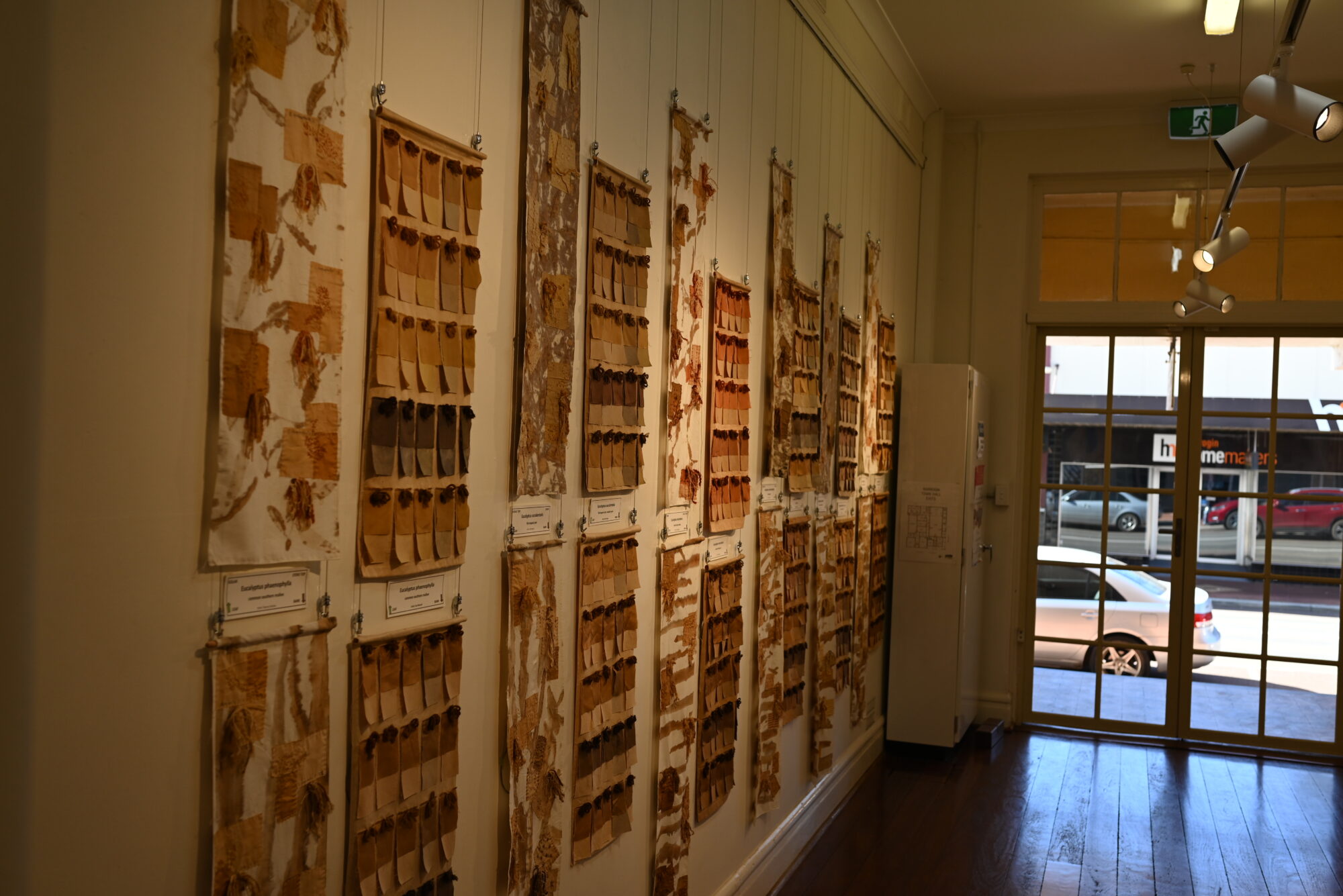
The result is extraordinary because it is so accumulative. Four years of testing, collecting and recording unfold throughout the NEXIS gallery in naturally dyed cloth, annotated swatches and layered documentation tracing the effects of season, tannin, fibre and heat. The room resembles, at different moments, a laboratory archive or a field journal, and seems both scientific and artistic all at once.
The swatches themselves are beautiful, but they also carry the weight of older eco-dyeing techniques that have too often been dismissed as peripheral or quaint. Variations in colour in the swatches indicate a change in mordant, a shift in pH, or the use of different fibres in the dyeing process. The palettes are unmistakably Australian; muted and autumnal, with salmon deepening to rusts and pale ochres bruising into iron-grey. The eucalyptus, long flattened into the generic category of “gum tree”, re-emerges as something individual and unexpectedly articulate.
Natural dyeing, of course, is not new. Across Indigenous communities in Australia and in cultures throughout the world, plant-based pigments once formed part of everyday material knowledge. But nineteenth-century industrial chemistry reordered that hierarchy of value, and synthetic dyes gradually displaced older expertise, relegating practices of slow observation to the margins.
Chasing Colours dismantles the assumption that natural dyeing should be dismissed as ‘niche’ or ‘nostalgic’. Without ever becoming polemical, the exhibition makes a persuasive case for the cultural and environmental value of Australia’s native flora as a sustainable source of colour, while demonstrating how colour testing can revive botanical knowledge and sharpen our ability to identify and understand species.

How it Started
For Dianne Strahan, the idea behind Chasing Colours began long before the exhibition itself. A botanical printer and textile artist, Di had spent years interested in the colour potential of local plants, particularly eucalyptus trees. Growing up near the Murray River in Victoria, she says the trees were a constant presence in her childhood and ‘part of her psyche.’ The exhibition grew from that long-standing fascination, and from
Di’s determination to understand eucalypts not as a generic feature of the Australian landscape, but as individual species with distinct characteristics, behaviours and palettes.
In 2022, Di, Sue Bicknell and Sally Rogers formed Eucalypts of Narrogin. The project came about organically through casual chats that gathered momentum over time, eventually settling on the concept to draw a 50-kilometre boundary around Narrogin and study the eucalyptus and botanical species within it.
The first year was largely devoted to experimentation, with the group testing different dyeing methods, recording results and gradually refining their process. Throughout that period, artist-scientist Helen Coleman became an important influence on the way the group approached the work. Drawing on decades of laboratory experience, Helen acted as both mentor and sounding board, encouraging the artists to think analytically about process while remaining open to experimentation and creative intuition.
Annette Nykiel also became an important collaborator and mentor within the project, contributing both fibre expertise and a geoscientific understanding of landscape and materiality. Annette worked closely with the group on the Heat vs Time project during the summers of 2023 and 2025, investigating the differences achievable on fabrics and threads through solar dyeing compared with repeated stovetop dyeing processes.
And early in the process, local eucalyptus expert, Peter White also helped the group develop their identification skills, before the work expanded into years of experimentation involving mordants, fibres and extraction methods. Di still delights in explaining the role of mordants, noting that the French word means “to bite”, describing the process by which pigment and fibre effectively bind themselves together.
Over four years, the artists have identified 37 naturally occurring eucalyptus species within the study area (with a 38th already waiting to be processed).

A Democratic Collaboration
Chasing Colours resists any singular authorship. The exhibition is grounded in a genuinely collaborative model in which scientific method, artistic practice and field observation are treated as complementary forms of knowledge.
The group describe themselves as “citizen scientists”, carefully documenting results while remaining open to experimentation and creative divergence. Ideas developed collectively between them, often during long walks through bushland, where one line of inquiry would quickly open into another.
From the beginning, the group was determined to freely share their results and process, so the launch of their website last year was a significant step.

The Reception (and the inability to stop)
The response to Chasing Colours has exceeded expectations. Beyond parliamentary recognition, audiences have been drawn to the extraordinary density of attention behind the work.
And the artists themselves show little sign of stopping. Di admits, laughing, that she has “an addictive personality and will keep going.”
“It is a labour of love,” she says. “We’ve become so familiar with the trees, with everything that we’ve done. We just love every moment.”
That sense of ongoing-ness feels central to the project’s significance. This is not a finished statement so much as a living archive that continues to expand with every collection trip and every new discovery.
And if there is one central revelation in Chasing Colours, it is this: the bush is not monochrome, nor is it static. Colour moves through it like weather.
Chasing Colours runs from May 10 – 30 across ARtS SPACE and NEXIS Gallery in Narrogin.
Opening hours are Tuesday to Friday, 10am – 4pm, and Saturday, 10am – 2pm