 Sophie Mathewson
Published on
Sophie Mathewson
Published on
Regional Arts WA Artist of the Month – Timika King
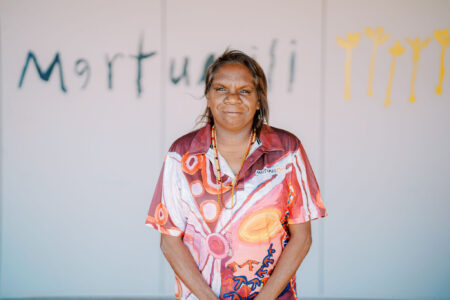
When I first chat to Timika King, she’s driving her car around Meekatharra collecting bikes for a charity fundraiser. Road trains rumble past (those monstrous mining trucks that dwarf everything else on the road) and she’s weaving through them, phone handsfree, talking about art and legacy and the weight of being a bridge between generations.
This is who she is: always moving, always doing, always building something from what others have discarded.
Timika is a First Nation’s woman who grew up on Meekatharra country in Western Australia’s Mid West. It’s a town of about 800 locals, maybe 2,000 if you count the stations and miners who use it as a service hub. It was established for gold and built on extraction, and is a place where there’s not much to do apart from the gym Timika tells me – that’s unless you create something yourself.
So that’s exactly what she’s done.
Paying It Back, Paying It Forward
Six years ago, Timika left Meekatharra. Instigated by a toxic relationship and the hope that a change of scenery might change everything. Unfortunately it didn’t, and four years ago she returned with her three daughters. For the first year, she sat on her arse (by her own admission), then her ADHD kicked in – she got bored, got a job, got a second job, and then thought to herself “bugger it, Timika, you need to start your own business”.
That business is Malya Mayu, which translates to “star child”. It’s registered as a creative consultant and entertainment service, though that feels too corporate for what it really is. A more accurate description might be a one-woman revolution against the systemic failures she sees in her community.

Inheritance
Timika’s creativity runs deep, and is rooted in a matrilineal line of makers and builders. Her great-grandmother, Avy Curley, carved an emu egg that she gifted to Prince Charles when he visited Australia decades ago. Another grandmother, Mavis Curley, helped establish the Nanas Club, an arts hub for Indigenous and non-Indigenous women in the community which became a place to go, to make, and to belong.
Her mother, a skilled and inventive upcycler, taught Timika to see creative potential in what others might discard. How to re-imagine materials and create something meaningful from what is already there.
That way of working came to life two years ago when Timika hosted the Barndi Mayu Fashion Show in Meekatharra, an exhibition of seven collections made entirely from mainly locally sourced materials. Upcycled denim from second-hand jeans was transformed into ball gowns, including a collection titled Blue Bayou. The show was created to celebrate the skills already present in the town and to give people, as Timika says, “a little chance to show what their talent was.”
“When you can get something happening, you gotta try and get everybody involved,” she says. “It has a beautiful effect on a little town.”

The Art of Survival
Timika paints, though not often. Music is her biggest creative outlet. She sings, plays ukulele, works as the local DJ and karaoke host. When she does paint, it’s usually because the world has become too much. “It’s a defence mechanism,” she admits. “I come to a not so great place and I’m like, you know what? Screw everything. I’m going bush with the canvas for a few hours.”
She works with acrylics on canvas, has sold pieces and taken commissions. Lately, she’s been experimenting with paperbark from the Northern Territory. You can buy it at McDonald’s wholesalers in Geraldton, she tells me, and apparently it’s meant for cooking, but Timika cuts it into strips to make headpieces adorned with native wildflowers for events like the local ball.
There’s a sustainable philosophy embedded in her work of using what’s already here, honouring what country gives you, and making beauty from what’s been overlooked.

The Gap
Timika describes herself as someone working to ‘close the gap on country locally,’ “I’m here for all people. Vulnerable Australia.”
She’s not interested in pressure or force but in showing up, creating space, and modelling what’s possible. She’s a single mother of three daughters and a grandmother to one granddaughter. A generation of girls watching her and learning from her. Her aim is to pay it back to her Elders and pay it forward to the future generations.

Luke the Yuke
Before we hang up, Timika tells me about Luke. Not a person, a ukulele. “Luke the yuke,” she calls him, and he rides shotgun in her car, strapped into the passenger seat with a seatbelt. If kids are too young, they sit in the back. Luke gets priority.
She’s laughing as she tells me this, and I can hear the pride, the humour, and the refusal to take herself too seriously even as she’s doing the most serious work imaginable. She’s fierce and funny, and she knows exactly who she is; a star child, a bridge, a woman who collects broken bikes and turns them into something whole again.
The road trains keep rolling through Meekatharra, but Timika King isn’t waiting for anyone to stop. She’s already building the future, one upcycled piece at a time.
*Timika King was a panellist at the Mid West Creative Ecology Summit hosted by Regional Arts WA in February 2025
Posted in Artist of the Month, First Nations, Mid West, News & Stories, Stories.